Did you ever learn something quite by accident, and then wonder, “Why did I never hear about this before?”
Here’s today’s lesson:
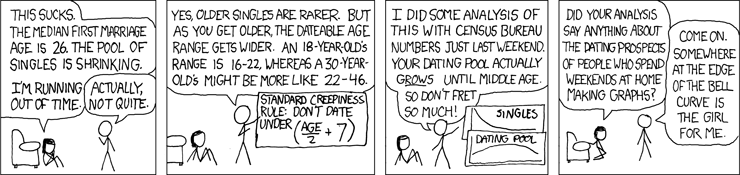
The Half-Your-Age-Plus-Seven Rule
(also, apparently, the “Standard Creepiness Rule”)
Perhaps you’ve heard of this. Perhaps everyone except me has. I have no idea, but I expect to find out shortly when this post is met with an an avalanche of kudos and/or derision.
As I have gotten older, it has seemed to me that the “pool of eligibles” might be increasing, in spite of the fact that fewer and fewer people my age are single. How could this be?
The answer apparently lies in the social acceptability of discrepancies in age among couples involved in... er, *ahem*... “intimate” relationships.
It seems like it’s kind of a no-brainer that the older a couple is, the less significant the difference in their ages becomes.
An 20-year-old man and a 14-year-old girl make an inappropriate (specifically, socially and culturally unacceptable) match (especially if the 14 year old is your daughter) while a 38-year-old and a 32-year-old have an age discrepancy that’s virtually insignificant and unlikely to raise an eyebrow. Interesting, but off-topic (though that has never stopped me before) is the observation that in the case of the younger couple, is that if I had not mentioned genders, you likely would have assumed the older one was male, but in the older couple, the assumption might not have been as obvious.
Granted, there are other factors that could make the above example more or less accurate, but as a rule, it seems intuitively obvious enough. And, of course, I’m speaking in the context of the present culture and society. Duh.
But what’s the secret code to this? If I’m contemplating the age ranges of women to date, ultimately to marry, what are the boundaries I might want to keep in the back of my head?
Again, granted, there’s no such thing as a hard-and-fast rule (to my tremendous dismay), since relationships and attraction are very subjective. It seems equally-likely that I’d find a 48-year old who was more desirable than a 28-year old as it would be the other way around (although I suspect some younger guys may be speculating, as a result of that statement, about my sanity — but trust me, “older” women are underrated in many, many ways), or, at a minimum, that the discrepancy in one direction (10 years in either case) might be more notable than the other — but in which direction? Intuition tells me the older one, but experience tells me the younger one. Again, it would be a very individual thing specific to the couple under consideration.
Age is only a number except for when it isn’t.
Imagine my delight, not only as a geek, but as an aspiring accountant, when I found a mathematical formula for all of this. Okay, okay, I already admitted that it’s not so simple as a formula, but there is a formula out there. A rule-of-thumb that does span multiple cultures.
(Minimum Age for Younger Individual) = (Age of the Older Individual) / 2 + 7.
That means at 38, my lower boundary to fit this rule would be 26. Intuitively, I had it figured for somewhere in the 25 to 28 range.
Interesting.
But how do we find my upper boundary? There’s not an upper boundary expressed by the rule, so I would have to go one of two ways to establish one:
- I could simply flip the difference. Since the lower boundary is 26 (12 years), the upper boundary would be 50. It seems sensible enough, though if this really were a mathematical formula, then I’m incorrect, because...
- I’d have to go the other way and back-into my upper boundary by calculating the oldest person whose minimum age would include me. Kicking in a little bit of algebra (wow — out of high school for 20 years and I can officially say this has all-of-a-sudden come in very handy!) we would subtract 7 from both sides of the equation, and then multiply by two. This formula would then be
[ (Age for Younger Individual) - 7 ] * 2 = (Maximum Age for Older Individual)
This formula puts my potential partner’s top age at 62.
I would have figured about 48, based on experience. Honestly, that’s probably tainted by perceptions of numbers ending in zeroes (after all, 50 sounds much older than 48... right?).
Of course, here we get into a lot of social biases and double standards.
There are pejorative terms that might be applied to a 62-year-old woman who pursues an 38-year-old man (specifically, a “cougar,” or, less commonly, a “cradle robber,” though this term seems to more often refer to a man pursuing a younger woman), but even then, society might not frown as harshly on the older man as it would the older woman, given identical circumstances.
One definition I found of “cougar” is a woman involved with a man at least 8 years her junior. Again, not a hard-and-fast rule, especially in this case, because being a “cougar” can also be more of a mindset (such as that of having a “boy toy” rather than a marriage-minded relationship) than a mathematical formulas.
There are a couple of additional factors working against the 62-year-old woman, even though I would technically comply with the rule applied to her: pulling the arbitrary age difference of 18 out of the air as the line of delineation of someone “old enough to be my mother” (the actual difference between my age and my mother’s age is 25 years), it seems potentially appropriate to factor this in, as well as the somewhat socially-objectionable concept of the “May-December” romance, although, again, this seems to apply more to an older man and a younger woman (he’s a “dirty old man” and/or she’s a “gold digger,” don’t you see).
So with that in mind, I’ll stick with the more intuitive but mathematically-incorrect way of doing the calculation, above, which provides an equal spread in years younger and years older.
So what’s my conclusion from all these calculations and gyrations?
First, it’s fascinating in this implication: For each year I get older, the age range predicted by this formula increases by a year (the younger boundary and the older boundary each move out from the center, my age, by half a year). At age 20, the age range for a partner would have been 6 years (17 to 23). Ten years later, the spread has increased by ten years (5 more on each side, for a range of 16 years) for a range of 22 to 38. At 40, there are another ten years, and a range of 27 to 53.
Translation?
There is one great thing about getting older. Okay, two things. First, you get less and less stupid each year. But also, the pool really is getting bigger.
Woohoo!
Anything else?
Yeah, as for the calculations... Screw it. For me at 38, 26-to-50 seems like a very sensible range. But if I were to meet someone outside that range, and really hit it off, I would not rule them out on the basis of this formula, though it does seem like I would be teetering on the brink of unrealistic expectations to think that a bigger discrepancy than this would not be without significant additional struggles.
But we’re pretty much back where we started: it depends on the individuals, and trying to apply a formula to something so complex makes the following all the more obvious:
If someone makes you happy, and you make them happy; if the relationship is mutual, loving, and legal, then go for it. Who am I, or who is anyone else, to tell you who you can fall in love with? We don’t choose it. It ultimately chooses us.


No comments:
Post a Comment